
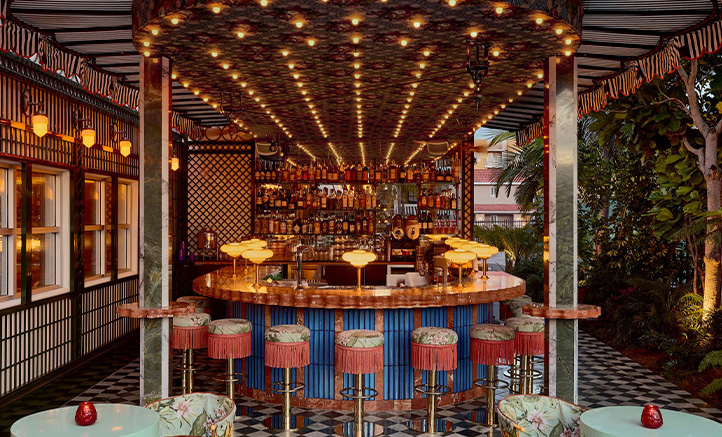
For more than a decade, hospitality design followed a fairly consistent script: pale palettes, clean lines, and restraint as a virtue. Now, across the industry, a new generation of hotels is embracing pattern clashes, saturated color, layered eras and theatrical detail. It’s a deliberate rejection of beige minimalism in favor of spaces that feel alive, opinionated and unmistakably memorable.
This is maximalist hospitality design, and it is having a real moment. But the most interesting properties working in this style understand something easy to overlook amid all that visual noise: a room this rich in pattern and texture needs an equally rich atmosphere to match. Without scent, even the boldest interior can feel like a stage set with the lights still off. With it, the whole space comes alive.
What maximalism actually looks like right now
Industry trend reporting from the past year points to a few consistent threads running through this style. Designers are layering plaid, florals and Memphis-inspired geometry against Art Deco curves and sculptural furniture, pairing crushed velvet and animal print with colored marble and jewel-toned finishes to create interiors that feel curated rather than decorated. The goal isn’t excess for its own sake. It’s a more expressive, guest-centric aesthetic that moves past neutral minimalism toward spaces that feel vibrant and genuinely lived in.
There’s also a strong undercurrent of nostalgia and storytelling. Many of the standout maximalist properties aren’t building from scratch. They’re reviving the bones of an older building and filtering its original character through a contemporary lens, mixing furnishings, eras and cultural references so guests encounter something that feels both familiar and entirely new. The result tends to be theatrical: a lobby that functions less like a check-in desk and more like a stage, designed to be moved through and discovered.
San Diego’s Lafayette Hotel: maximalism as a complete sensory world
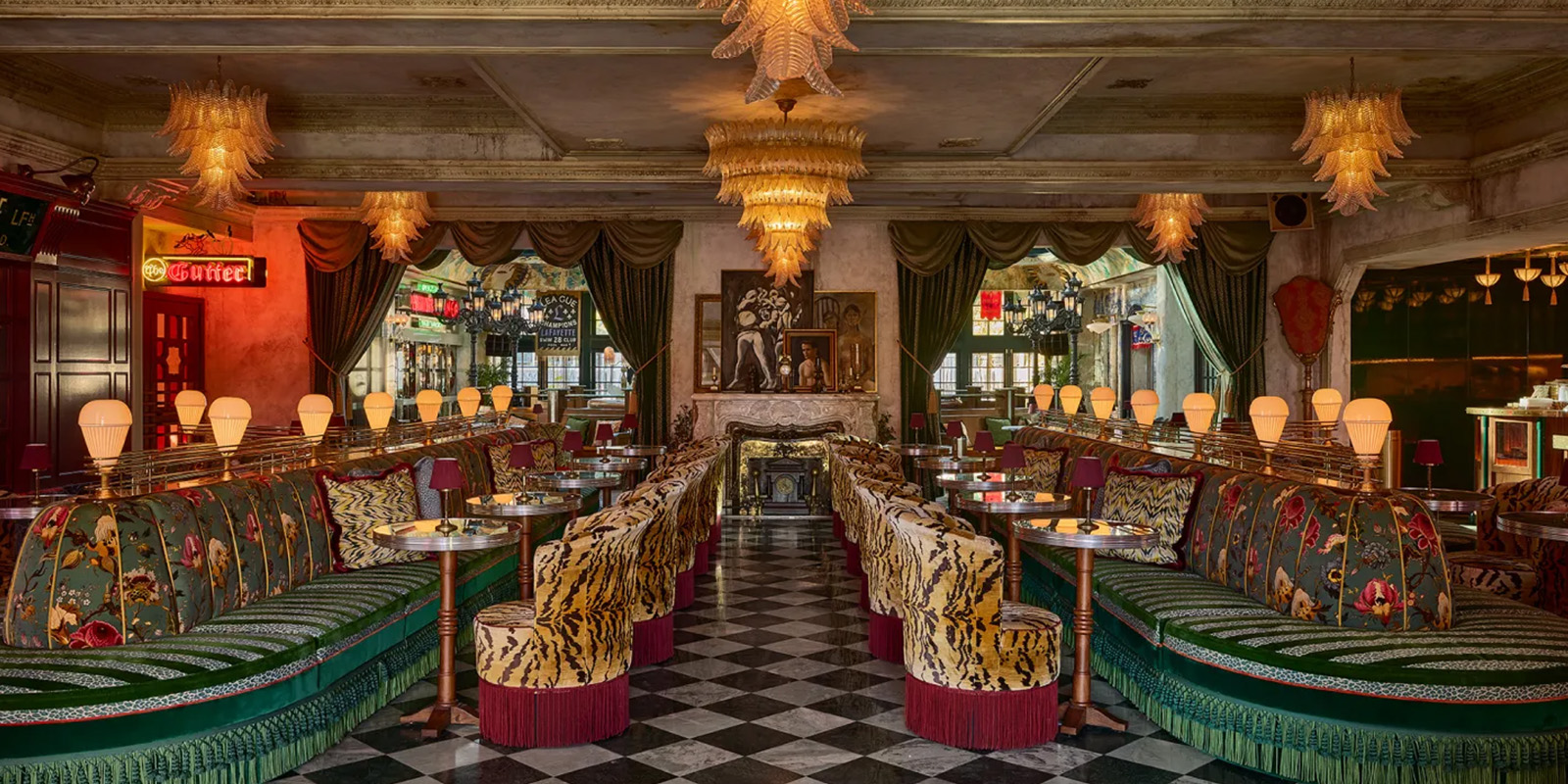
Few recent projects illustrate this better than the LaFayette Hotel & Club in San Diego. Originally opened in 1946 as a Hollywood-era retreat for stars like Frank Sinatra and Ava Gardner, the property sat in decline for decades before hospitality group CH Projects and Brooklyn-based studio Post Company took it through a $31-million transformation that reopened in 2023, filtering the hotel’s old-world glamour through a lens of irreverent maximalism.
The results are exuberant by design. The main entry mixes tiger print and floral upholstery with checkered tile flooring and palm-tree shaped chandeliers, all sitting beneath the gilded wainscotting of the original structure. Beyond it, the lobby unfolds like a town square, anchored by a massive Atlas statue under a domed skylight, with a circular bar and a row of “storefronts” that includes a fully functional mid-century diner. In Lou Lou’s Jungle Room, the hotel’s former jazz stage, leopard print, feathers and forest-canopy patterns collide under green velvet drapery, with a shell-shaped stage framed by fringed animal-print seating. It’s a property built on the idea that hospitality at its most ambitious is theatre. CH Projects founder Arsalun Tafazoli has described a hotel as hospitality’s most complex canvas, a place where people can socialize and connect deeply. Every surface at the LaFayette was considered with that brief in mind, down to custom-sculpted furniture pieces and hand-drawn wallpaper made in collaboration with the design studio.
Scent was treated with the same intentionality. The LaFayette’s signature fragrance sits in an herbal, woody fragrance family, and feels spicy, sueded and warm. It’s built on bergamot, lemon and orange against nutmeg, cardamom, coriander and clove, settling into a base of jasmine, musk, amber and patchouli. It’s a profile that mirrors the architecture of the space itself: a bright, citrus-led opening that echoes the property’s sun-soaked, Old Hollywood energy, a spiced heart that brings the same warmth as velvet and brass and gilded detail, and a smoky, ambered base that gives the whole experience weight and permanence, the same way a domed skylight or a hand-carved bar gives a room gravity. The scent doesn’t sit on top of the design, but rather moves through it the same way the eye does.
Why maximalist spaces need scent more, not less
It would be easy to assume a maximalist room is already doing enough work on the senses, and that fragrance risks tipping it into overload. In practice, the opposite tends to be true.
A few principles seem to separate scenting done well in these spaces from scenting that feels like an afterthought.
Scent gives a layered room a single throughline. Maximalist design intentionally combines many visual ideas, eras, patterns, materials, in one space. Fragrance is one of the few elements that can move through all of those zones at once, giving a guest’s nervous system one consistent signal even as their eyes are taking in a dozen different things. It becomes the quiet organizing principle behind the visual abundance.
Warm, spiced and resinous notes read as “rich” the way pattern and color do. The same instincts that draw maximalist designers toward jewel tones, velvet and gilded brass tend to translate into fragrance through notes like clove, cardamom, amber and patchouli. These are not quiet, minimalist scent families. They carry weight, depth and a certain old-world opulence, the olfactory equivalent of a clashing pattern done with confidence rather than restraint.
It supports the nostalgia these spaces are built on. Much of today’s maximalist hospitality design draws on revived heritage buildings and mid-century or Art Deco references. Spice, resin and amber-forward fragrances carry that same sense of history and glamour, evoking old hotel bars, vintage perfumery and grand interiors in a way that clean, modern scent profiles simply can’t.
Citrus keeps it from tipping into heaviness. The brightness at the top of a composition (bergamot, lemon, or orange), does real work in a maximalist context. It keeps a richly spiced, resinous base from feeling overwhelming or dated, like the same balancing act the design itself performs by pairing bold pattern with confident editing rather than letting every surface compete for attention.
Scent supports the “stay and discover” experience these hotels are designed around. Maximalist hospitality spaces are built for lingering, for guests to move through different rooms and uncover new details. A signature scent that travels consistently through those spaces reinforces that sense of a single world worth exploring slowly.
Treating fragrance as a design material, not an amenity
The properties getting this right, the LaFayette among them, aren’t adding scent after the interior is finished. They’re treating it the way they’d treat a custom finish or a bespoke fabric: as a material with its own character that needs to be chosen in dialogue with everything else in the room. It’s considered early on in the conversation and planning process.
For a maximalist project, that means asking the same questions of a fragrance brief that a designer would ask of a color palette or a textile: Does it carry enough warmth and spice to match the richness of the visuals? Does it have a bright enough opening to keep that richness from tipping into heaviness? Does it tell the same story the architecture and the furnishings are already telling?
Get that right, and scent stops being something a guest notices in passing. It becomes one more reason the room feels inevitable, as though it couldn’t smell like anything else.
